Food Keeps Getting Stuck Between the Same Two Teeth? The Problem May Not Just Be a Wider Gap
You used to eat meat and vegetables without a second thought. Recently, however, something has changed: after almost every meal, food is trapped in exactly the same spot between two teeth.
The first explanation that comes to mind is age — the gaps between the teeth must be getting wider. Wider gaps do trap food. But if your teeth never trapped food before and it has started suddenly, repeatedly, and always in the same place, the better response is not to shrug it off. It is to find out why.
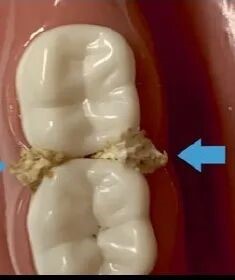
In clinical practice, food impaction — food being forced and lodged between the teeth — does not have just one cause. A wide gap is only the most obvious one.
1. The Contact Between Two Teeth Has Loosened
Two adjacent teeth are not completely separate. Where they meet, each pair shares a contact area — a snug junction that, during chewing, stops food from being pressed down onto the gum between them.
When that contact becomes less tight, a very characteristic change follows: food that never used to enter the gap now lodges there at almost every meal.
Why would a contact that was once tight become loose?
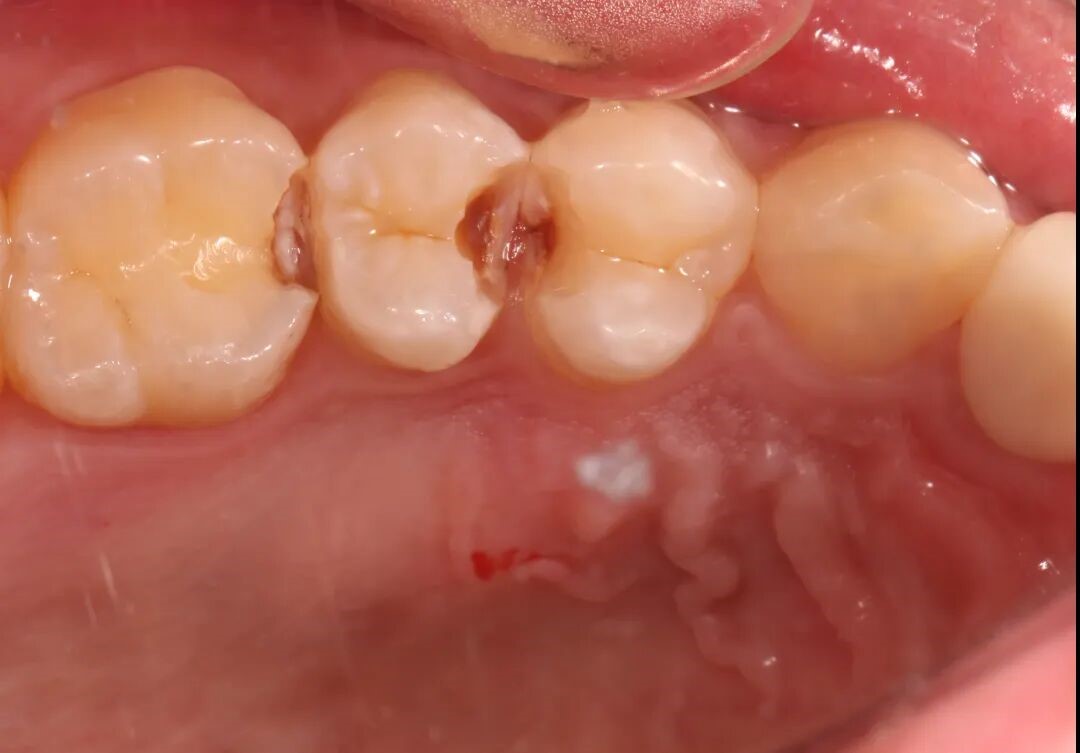
Tooth decay between the teeth. Proximal caries — a cavity forming on the side of a tooth where it touches its neighbour — quietly eats away the contact surface. These cavities are invisible in the mirror and often painless at first, which is exactly why the first symptom is trapped food rather than toothache.
A worn or damaged filling. Where a tooth has been repaired, the restorative material can wear down, chip or fail over the years, changing the original contact between the teeth.
Crowns and inlays with altered contacts. A crowned or inlay-restored tooth whose neighbouring contact has changed shape or position is also a common site for food packing.
Research on food impaction consistently lists loss of the proximal contact as one of the most frequent causes. In other words: if food has started trapping in a new place, the surface where those two teeth touch is one of the first things a dentist will examine — usually with a bitewing radiograph, because decay between teeth cannot be seen with the naked eye.
2. The Gap Looks Tight — Yet Food Still Traps
There is another situation that puzzles patients: the gap is not really wide at all, and yet food traps every day.
Patients often say: "Doctor, I tested it with floss. The two teeth fit tightly together. Why does food still get stuck?"
The answer is that teeth are not motionless when you eat. Under the forces of chewing, adjacent teeth undergo minute movements. If a cusp — a pointed ridge of a opposing tooth — happens to wedge food toward the contact between two teeth, or the contact opens momentarily under occlusal load, food will be driven into a space that looks perfectly closed when you check it in the mirror or with floss afterwards.
This is why the width of the gap alone is not enough information. The bite, the shape of the cusps, the direction from which food is being pushed, and the position of the teeth all matter. Dental research also lists abnormal occlusion and malpositioned or tilted teeth among the causes of food impaction.
Patients often notice a tell-tale pattern at the table:
Rice, noodles, soft dishes — nothing happens.
Stringy meat, fibrous vegetables, gristle — the same spot traps immediately.
Fibrous food acts like a wedge: it exploits any weakness in the contact or the bite. That pattern — fine with soft food, immediate with fibrous food — suggests the question is not just oral hygiene, but whether the structure between those two teeth has changed.
3. Gum Recession Creates Gaps That Were Never There Before
Some patients’teeth have not moved apart at all. What has happened instead is that the gums have receded, exposing an area that gum tissue used to cover.
Looking in the mirror, these patients notice that the roots of their teeth look “longer”, and that a small triangular gap — the black triangle — has appeared between two teeth. Food settles and stays in that space easily.
If the roots are becoming visible and the gaps are getting more obvious, it is worth having the periodontal tissues checked at the same time. Gum recession in an adult is not a cosmetic curiosity; it is usually the visible end of a process that also involves the bone around the teeth.
4. Do Not Just Dig the Food Out with a Toothpick
Picking out the trapped food with a toothpick solves the moment, not the pattern. It removes the piece of meat in front of you; it does nothing about why the same site traps every day.
Worse, repeatedly jabbing a coarse wooden toothpick into the gum damages tissue that may already be inflamed or receding. Patients who do this daily often find the area increasingly sore, and the recession slowly deepens.
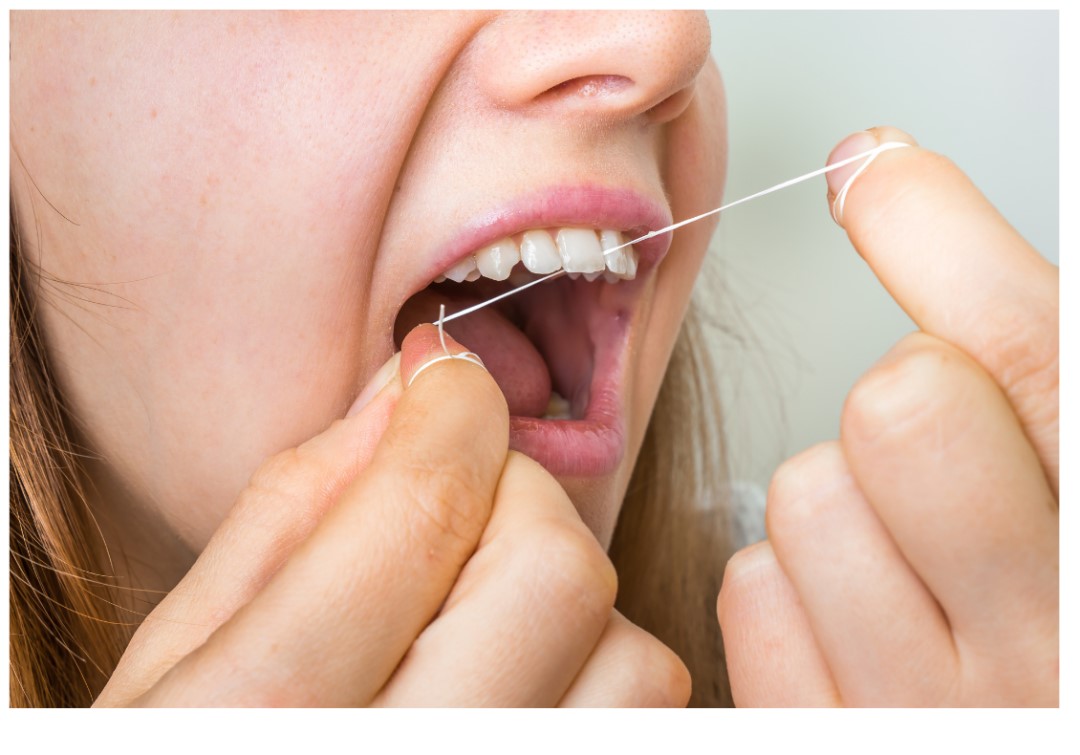
For daily cleaning, choose floss or an interdental brush sized to fit the space snugly without force. But be clear about what these tools do: they clear the residue of this meal. They do not replace the examination that explains why the trapping started.
When Trapped Food Needs a Dental Appointment
Occasional food trapping, in a gap that has always been there, is part of normal life. The situations that warrant an examination are different:
Food has been trapping at the same site for several consecutive days — a pattern that has newly started;
the area also shows bleeding, persistent odour, sensitivity to hot and cold, or pain on biting;
the tooth concerned already has a filling or a crown,and the trapping is new or worsening.
What truly deserves attention is not the occasional leaf of vegetable stuck after dinner. It is the change itself: never used to trap, now suddenly does, always in the same place. That change is a signal that needs a cause.
Whether the problem lies in the contact between two teeth, in decay between them, in an aged restoration, or in the bite cannot be distinguished by picking the food out. It takes a clinical examination and, usually, a radiograph — and most of these causes are straightforward to treat once identified: a small filling restores a contact, a renewed crown re-establishes it, and early gum disease can be stabilised before it costs more.
This article is intended for general patient education and does not replace an individual clinical examination. If food has started trapping between the same two teeth, or you have bleeding gums, sensitivity, or pain on biting, book an examination at https://www.vkdentistrys.com [Wheat], Hong Kong.