Gum Disease and Alzheimer's: How Oral Bacteria May Affect the Brain
Gum Disease and Alzheimer's: How Oral Bacteria May Affect the Brain
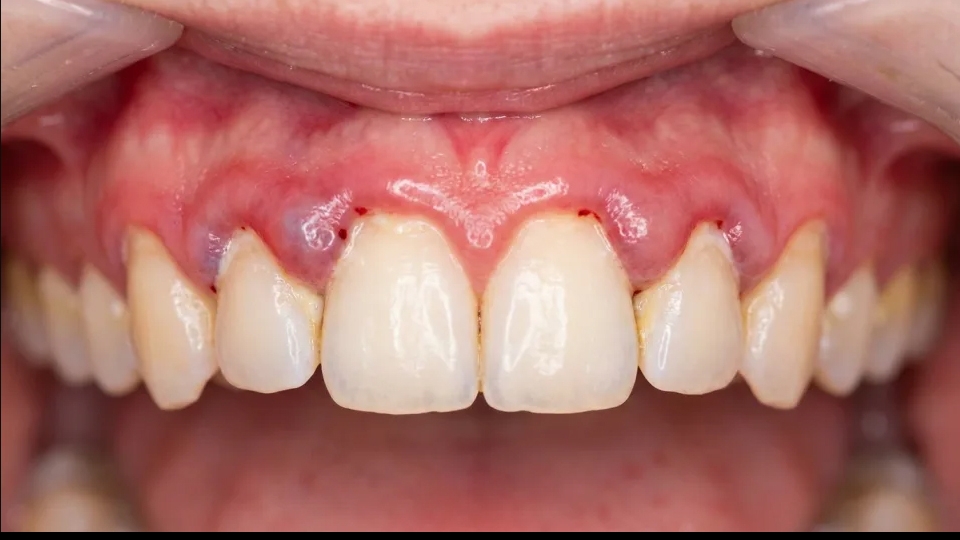
Have you seen this before? An older relative keeps forgetting things — a sentence you just said slips away minutes later. At the same time, their gums bleed when they brush, and a few teeth have started to feel loose. Most of us file these away as two separate issues: poor memory is just “getting older,” and bad teeth are “a dental problem.”
But a growing body of research suggests periodontal disease may not be a purely oral problem — it may be connected to the development and progression of Alzheimer's disease.
Let's be clear about the conclusion first: the existing evidence supports an association, not a proven cause. We cannot yet say that gum disease causes Alzheimer's. But controlling periodontal inflammation may be one way of taking load off the brain. That distinction matters, and this article will keep it.
What Is Alzheimer's Disease?
Alzheimer's disease (AD) is a neurodegenerative disorder of the central nervous system, characterized by progressive cognitive impairment and behavioral change. It presents as memory loss, language difficulties, declining visuospatial ability, impaired abstract thinking and calculation, and changes in personality and behavior.
It is the most common form of dementia in older adults, accounting for roughly 60 to 80 percent of all dementia cases. In other words, it is not simply “poor memory in old age” — it is a brain disease that progresses steadily and progressively strips away cognitive function and the ability to live independently.
What Actually Happens in the Brain? Three Analogies
1. Amyloid-Beta Plaques: The Brain's Trash Is Not Being Taken Out
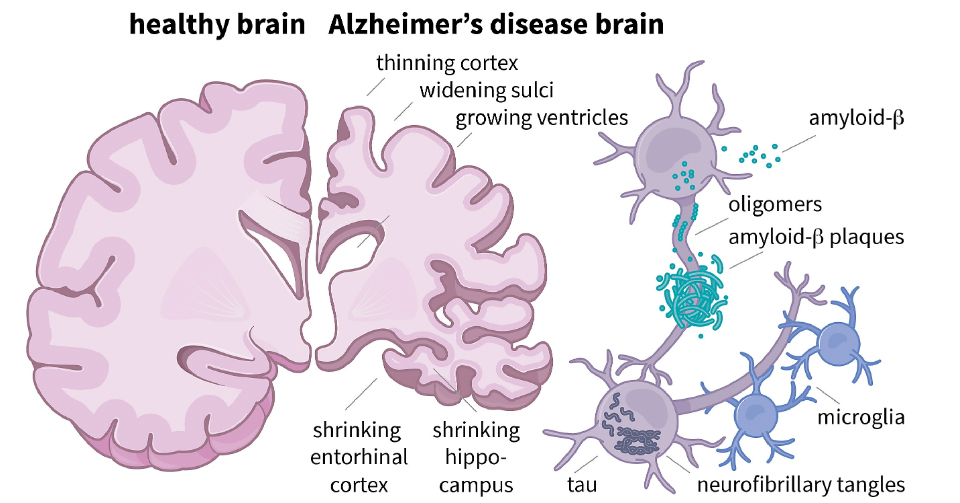
Abnormal protein fragments called amyloid-beta (Aβ) accumulate outside nerve cells, forming amyloid plaques (historically called senile plaques). A healthy brain clears this material. In the AD brain, production and clearance fall out of balance, and Aβ keeps piling up.
2. Tau Tangles: The Neuron's Skeleton Breaks Down
Inside nerve cells, a structural protein called tau normally stabilizes microtubules. In the AD brain, tau becomes hyperphosphorylated, detaches from the microtubules, and clumps into neurofibrillary tangles. The neuron's internal transport system collapses, and the neuron eventually dies.
3. Neuroinflammation: The Brain's Fire Alarm Never Stops Ringing
The brain's resident immune cells, called microglia, are meant to clear harmful material. Under continuous Aβ stimulation, they shift into a chronically activated state and release large quantities of inflammatory cytokines. This inflammation fails to clear Aβ effectively — and it actively promotes the spread of tau pathology, accelerating neuronal damage.
AD also involves cholinergic system dysfunction and genetic risk factors. APOE ε4 is one of the strongest genetic risk factors for late-onset AD: carriers face a higher risk. But carrying the allele does not mean you will develop the disease.
AD is therefore best understood as a multi-hit disease: Aβ accumulation, tau tangles, neuroinflammation, and genetic susceptibility are interwoven pathways that together drive progression.
How Periodontal Disease May Influence Alzheimer's
Periodontal disease is a chronic infectious inflammation. One of its principal pathogens is Porphyromonas gingivalis. This bacterium not only destroys gum tissue and alveolar bone, it also releases toxic substances including gingipains and lipopolysaccharide (LPS).
Research has found that higher P. gingivalis burden tracks with more severe AD pathology. The problem is that these bacteria and their toxins do not necessarily stay in the mouth.
Pathway 1: Bacteria Invade the Brain Directly
Periodontal pathogens may spread through the bloodstream, or travel along neural routes such as the trigeminal nerve, into the central nervous system. Studies have detected periodontal pathogens and their components in the brain tissue and cerebrospinal fluid of AD patients. Gingipains released by the bacteria have also been found within Aβ plaques in AD brains.
The most cited evidence here is a 2019 study published in Science Advances. The researchers found gingipains in the brains of Alzheimer's patients at two to three times the levels seen in non-demented controls, and showed that oral P. gingivalis infection in mice led to brain colonization and increased production of Aβ42 — the key component of amyloid plaques. Importantly, they also showed that gingipain inhibitors reduced bacterial load, blocked Aβ42 production, reduced neuroinflammation, and rescued neurons in the hippocampus.
Pathway 2: Systemic Inflammation Strikes from a Distance
Even if the bacteria never reach the brain directly, periodontal disease acts as a persistent infection site that releases pro-inflammatory cytokines into the bloodstream — including IL-1β, TNF-α, and IL-6.
These inflammatory mediators can compromise the blood-brain barrier, allowing more harmful substances to enter the brain and directly triggering neuroinflammation. And neuroinflammation is precisely the driver that accelerates Aβ deposition and tau hyperphosphorylation.
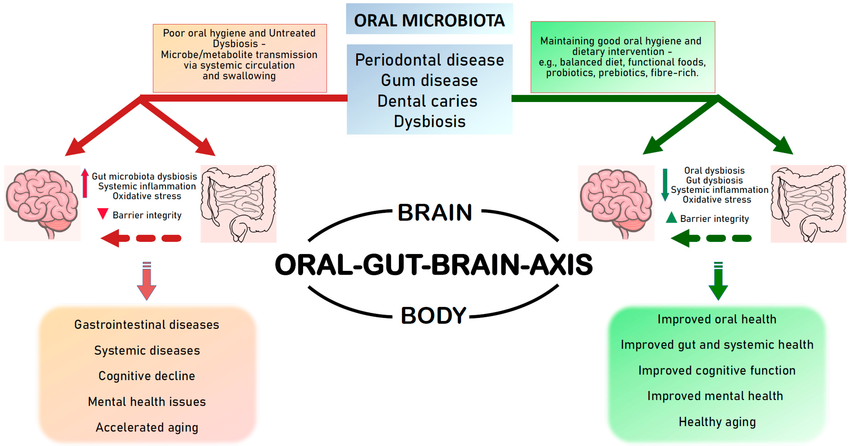
Pathway 3: The Oral–Gut–Brain Axis
Newer research suggests periodontitis may also disrupt gut microbiome homeostasis, further aggravating brain pathology through the oral-gut-brain axis.
Put simply: the chronic inflammatory environment created by periodontal disease gives a direct assist to the single most central pathological pathway in AD — neuroinflammation.
The More Troubling Possibility: A Vicious Cycle
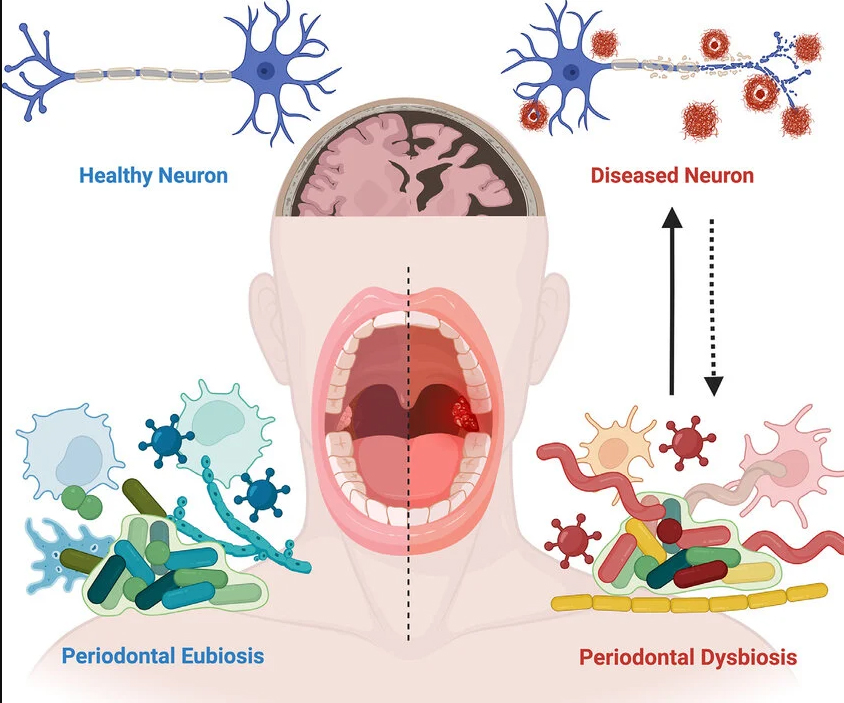
The relationship between periodontal disease and Alzheimer's may be bidirectional.
As cognition declines in AD patients, brushing teeth, flossing, and attending dental appointments all become progressively harder. Oral hygiene deteriorates, periodontal infection worsens — and worsening periodontal infection may in turn accelerate cognitive decline.
The result is a self-reinforcing loop: poor dental health → more inflammation → brain damage → reduced self-care → even worse dental health.
How Strong Is the Evidence?
| Question | What the evidence shows |
|---|---|
| Is there an association? | Yes. Multiple population studies and meta-analyses find that people with periodontitis have a higher risk of dementia and cognitive decline. |
| Has the bacterium been found in AD brains? | Yes, in several postmortem studies — including P. gingivalis DNA, gingipains, and LPS. |
| Has causality been proven in humans? | No. Animal models show plausible mechanisms, but human causal evidence requires long-term prospective trials that have not yet been completed. |
| Could the arrow point the other way? | Possibly. Reverse causation is plausible: early dementia can degrade oral hygiene, so poor dental health may partly be a consequence of cognitive decline. |
| Is periodontal disease an official dementia risk factor? | Not yet. The 2024 Lancet Commission lists 14 modifiable dementia risk factors accounting for roughly 45% of cases — periodontal disease is not among them, though a growing literature argues it deserves consideration. |
Warning Signs: When to See a Periodontist
Gums that bleed when you brush or bite into hard food
Persistent bad breath
Red, swollen, or receding gums
Loose teeth or widening gaps between teeth
Gum pain or pus discharge
If any of these are present, do not wait. See a periodontist.
What You Can Actually Do
The honest position is that periodontal treatment has not been proven to prevent or slow Alzheimer's disease. But it is proven to treat periodontal disease — and that is worth doing on its own merits.
Brush for two minutes, twice a day, with the Bass brushing technique.
Floss or use interdental brushes daily.
Book a professional cleaning every 6 to 12 months.
Take your parents for a dental checkup once a year — especially if you have noticed memory changes, because self-care tends to decline first.
Tonight, brush your teeth for an extra 30 seconds and floss once. That is a small habit with an outsized return.
Frequently Asked Questions
Does gum disease cause Alzheimer's disease?
Not proven. Current evidence supports an association and demonstrates plausible biological mechanisms in animals, but no human study has established causation. It is more accurate to say that periodontal disease may be a contributing or accelerating factor in some cases.
Can treating gum disease prevent dementia?
We do not know yet. No trial has shown that periodontal treatment lowers dementia risk. What is established is that treating gum disease improves oral health, reduces systemic inflammation, and prevents tooth loss — all worthwhile regardless.
Can Alzheimer's disease make gum disease worse?
Yes, plausibly. Cognitive decline and reduced motor coordination make brushing and flossing harder, and some medications for dementia cause dry mouth, which raises the risk of decay and gum disease. This is one reason the relationship may run in both directions.
How might oral bacteria reach the brain?
Through the bloodstream, or along nerve pathways such as the trigeminal nerve. P. gingivalis DNA and gingipains have been detected in the brain tissue and cerebrospinal fluid of Alzheimer's patients.
What is the hygiene routine for an older adult with memory problems?
An electric toothbrush with a round head is often easier to use, and a caregiver may need to assist or supervise brushing. Book professional cleanings every 3 to 6 months rather than annually, and tell the dentist about any medications that cause dry mouth.
Key Takeaways
Gum disease and Alzheimer's are associated, but causation has not been proven. Be skeptical of headlines that say otherwise.
Alzheimer's pathology involves Aβ plaques, tau tangles, and neuroinflammation — and neuroinflammation is the pathway gum disease plausibly feeds into.
P. gingivalis and its gingipains have been detected in Alzheimer's brains, and animal studies show oral infection can produce AD-like pathology.
The relationship may be bidirectional: cognitive decline worsens oral hygiene, which worsens inflammation, which may accelerate decline.
Periodontal disease is not yet an official dementia risk factor, but it is a treatable, modifiable condition with clear benefits in its own right.
Brush, floss, and book regular professional cleanings — and take your parents to the dentist.